 Facebook
 X
 Threads
Then came the part only your team saw: designs that didn't work, tests that failed, the long nights until you had the answer. You came out with something your field didn't have, and a team that had changed along the way. The answer lives in your lab and in your engineers' heads, and it's tempting to let the work speak for itself.
Meanwhile your market is choosing whom to trust with what comes next. When a customer picks a partner or an investor picks a company to back, they choose the team they believe can solve the next hard problem, and they decide from what they have already heard about the last one you solved.
Telling your story starts from your core truth: what your company has achieved that no one else has, and why that matters to the people who buy from you.
Your story has to hold up in front of customers, investors and the engineers who will check every line, told the same way everywhere your market meets you: on your website, in your presentations and by your people. When it does, your company speaks the language of both worlds, the one your engineers work in and the one your buyers live in.
YOUR MARKET IS DECIDING WHO LEADS IT
Attention often goes to whoever speaks first, and the hardest work can go unnoticed for a while. Aerospace is growing in pockets, some of them brand new. A 2021 Deloitte and Aerospace Industries Association study forecast advanced air mobility in the United States at about $115 billion a year by 2035, and the World Economic Forum and McKinsey project the global space economy will grow from $630 billion in 2023 to $1.8 trillion by 2035. Growth markets fill up with companies, and customers and investors have to decide which of them to take seriously.
They decide from what they see and hear. Part of it is the material you publish: your website, your presentations, your brochure, your booth, your posts. Just as much of it is your people: what your engineers say at a conference, how your sales lead describes the company, how your CEO answers a question on a panel. Together, that is your brand.
Investors read the same brand. A fund weighing your next round reads the deck, then looks at your website, your press and your posts, and listens to how your team describes the company. When the deck says one thing and the website says another, the investor has a reason to doubt the rest. Your customers and your investors should meet the same company. In aerospace they are often the same company: Boeing invested in EPS and bought its battery packs.
In a 2012 Gallup survey of more than 3,000 American workers, only 41% strongly agreed that they knew what their company stands for and what makes it different. The gap ran by rank: 60% of executives agreed, against 37% of employees outside management. Gallup concluded that when employees don't know who the company is and how it's different, customers are unlikely to know either.
That gap shows up in growing companies all the time. The website says one thing, the investor presentation says another, the booth says a third, and the people at the booth describe the company their own way. The market hears several companies and can't see what sets you apart. The work your engineers know best, the part that took the most, is the part buyers are least likely to hear about. A company's story should be built around its core truth: the unique positioning no one else has.
WHERE THE WORK USUALLY STARTS
My team at KAIA has spent 30 years making technology clear to the people who buy it and fund it. We've won an Emmy doing it, and we've presented NASA, FAA and DARPA programs to the people those programs had to win.
Here is how it usually goes. A trade show is coming, and the company needs a new website. A web firm builds it, and the pages look good. Then a different firm writes the brochure from a different brief, and a third makes the launch video. Every piece arrives on time, and each tells the story a little differently.
By the time anyone notices, the next piece is already due, and someone has to work back to the strategy no one had time for. Who is this for? What should they believe when they're done? What is true about this company that isn't true of anyone else? Those questions get answered in a rush, and the answers show it.
We prefer to work the other way, starting with the core truth before the first deliverable. That means time with the leadership who set the direction and the engineers who know the product's limits, plus research into how customers and investors talk about the market. The result is a short, plain statement of what the company achieved, what it took and why it matters to buyers. Then every piece starts from the same place, and the market sees one company.
HOW IT PLAYED OUT WITH EPS
Electric Power Systems, in Logan, Utah, builds lithium battery systems for aircraft. Its core technology was a lightweight battery case that could contain a fire, and was built in a modular design that EPS was manufacturing at scale to fit many aircraft types. Their batteries passed what EPS called "the FAA's stringent DO311A full thermal runaway safety containment test." Because the case isn't heavy metal, the batteries keep the power density an aircraft depends on. EPS also built its own plant, so it could deliver batteries ready for flight.
That put EPS at the front of electric aviation. Many of the first electric aircraft to fly did it on EPS batteries. NASA chose EPS to build the battery pack for the X-57 Maxwell, its all-electric experimental airplane, with the pack designed so a fire in one cell would stay contained. Diamond Aircraft chose EPS batteries for its all-electric eDA40 trainer, and SkyDrive chose them for its production air taxi.
EPS has been our client since 2021. Our job was to make sure customers and investors saw the company the aircraft builders already knew. Since 2021, EPS's leadership has raised four investment rounds, from a $13 million round that brought in JetBlue Technology Ventures in 2022 to a $29 million round in 2025, with United Airlines Ventures investing along the way. We built the visuals for its investor presentations on the same story as its customer materials, so investors and customers met one company.
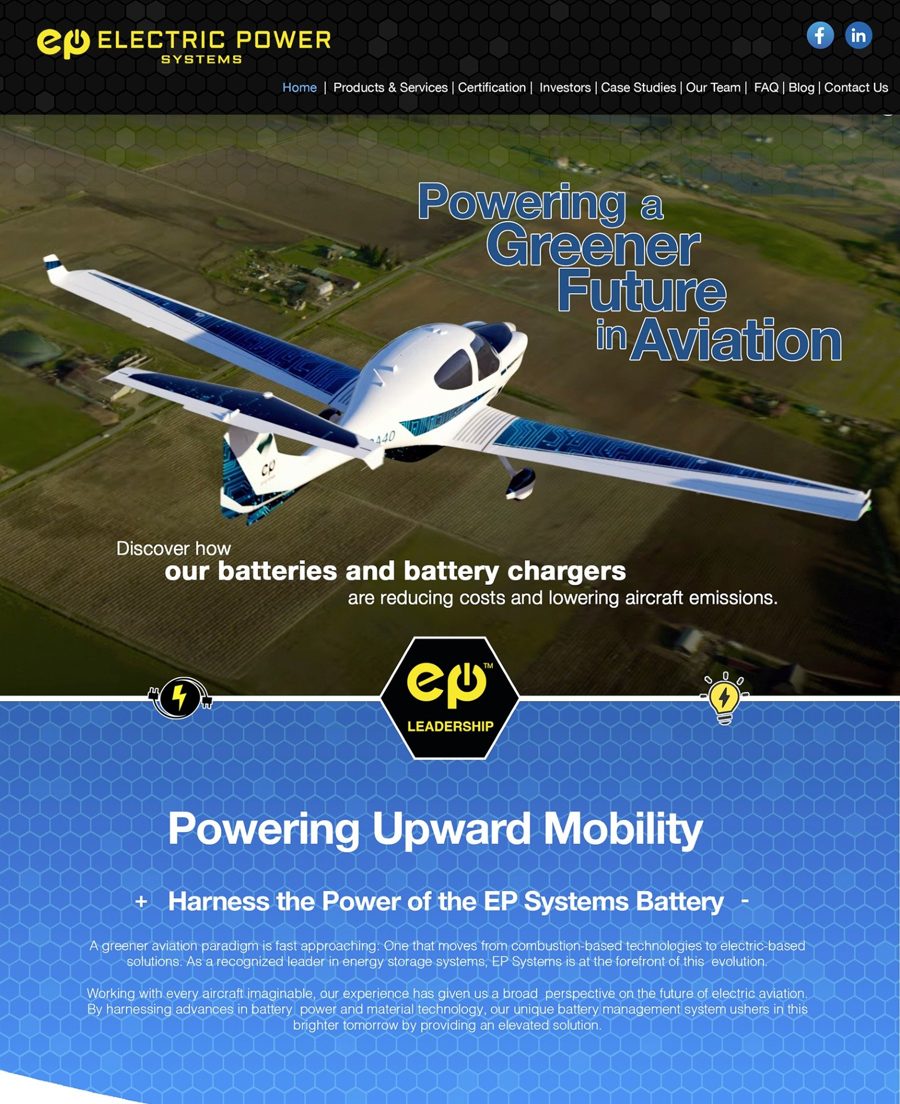
Our website design made sure buyers saw who already trusted the company. It put the company's accomplishments up front, in large, beautiful images of the aircraft flying or in development with its batteries, from NASA's X-57 to Bell's Nexus air taxi. Our social videos from the plant let customers see where their batteries were built, and our 3D renders put the battery pods on Diamond's trainer and SkyDrive's air taxi, two programs the company was powering.
Our messaging made sure the market heard what only EPS could claim. Much of the market talked about electric flight in green terms, and the early pieces did too. As the work went on, the story moved to a battery that could contain a fire, light enough to fly, built in a modular design in its own plant. An animated video showed that module across 13 aircraft, so builders could see one battery fitting theirs. The brochure answered customers' first two questions, safety and support. The trade show wall put the lightweight case in one line, "High power and energy in a compact, light-weight package," and the trifold showed flight hardware the company was already shipping, ahead of almost every other aviation battery maker. The identity video closed on "Power Upward Mobility," and the website opened on that line and "Powering Safer World," so every visitor met the company's direction and its fire containment first.
Our search program made sure buyers could find it. The maker of the battery pack for NASA's X-57 had started out below position 50 in the searches its buyers ran. After our SEO campaign, traffic was up 19.2% and the company appeared first or second in most of the searches we tracked. When EPS applied to the FAA for approval of its EPiC battery system, with more than 2,600 pages of compliance data behind it, its market could already find it and see what it had built.
We didn't set EPS's direction. Its leadership did. Our part was to research that direction with them, find the words that said it accurately, and build every piece to speak to their customers and investors.
THE TAKEAWAY
DEFINING THE CORE TRUTH COMES FIRST
The early pieces each answered the brief in front of them. The later ones, built from leadership's own outline and EPS's own vision, held from one piece to the next because they described what the company is. "Upward Mobility" ran from the identity video to the trifold to the website because it came from EPS and described where the company was taking its industry.
A style guide keeps the logo, the colors and the type the same. Getting the materials and the people to say the same thing takes a shared idea underneath them, and that idea has to be defined before the first deliverable. It's done with the people who set the direction and the people who built the product. It ends in a statement short enough for anyone in the company to repeat, and it puts the hard part where buyers can see it.
THE BRAND IS EVERYTHING THE MARKET HEARS
A website, a brochure and a booth are the part of the brand a company controls directly. The rest is its people. The social series showed EPS's plant and the people building its batteries, and those people are as much a part of the brand as the logo.
Gallup's numbers show why that matters. If fewer than half of a company's employees can say what makes it different, the market hears as many versions of the company as it meets people. A story built on the core truth gives everyone in the company the same thing to say, because it describes what they already know is true about their work.
Both come down to a test that takes one conversation. We ask five people at the company, from the CEO to an engineer on the floor, what makes the company different. When the answers match, the core truth is defined. When they don't, that's where the work starts, and it's worth knowing before the next website or brochure is due.
WHERE THE MARKETING STARTS
What you might find surprising is which lines lasted. In 2025 EPS opened a new page on its website with a line we wrote for the 2022 identity video: "As the world changes, we search for new ways to innovate and build a better tomorrow." "Upward Mobility" outlasted the brochure it first appeared in.
Those lines lasted because they were EPS's own words, found with its leadership. They told the market what EPS had done for electric flight and where it was going. That is what a buyer, or an investor, needs to hear about your company, in your own words, before trusting you with the next hard problem.
Jon Levy, KAIA